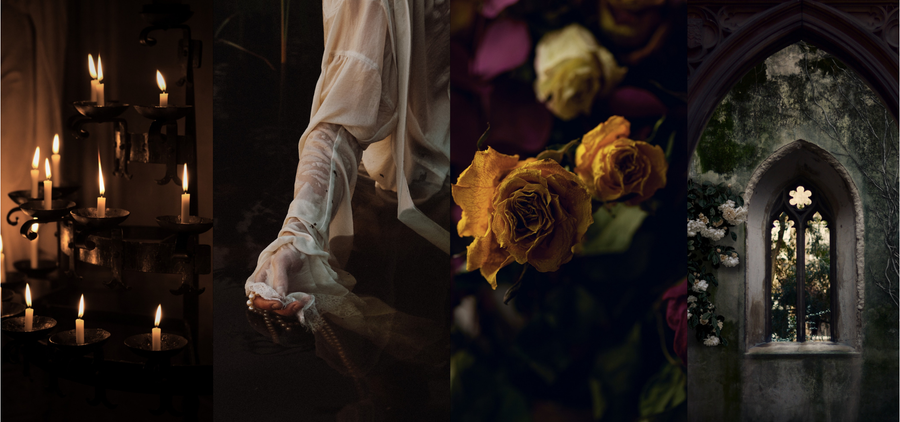
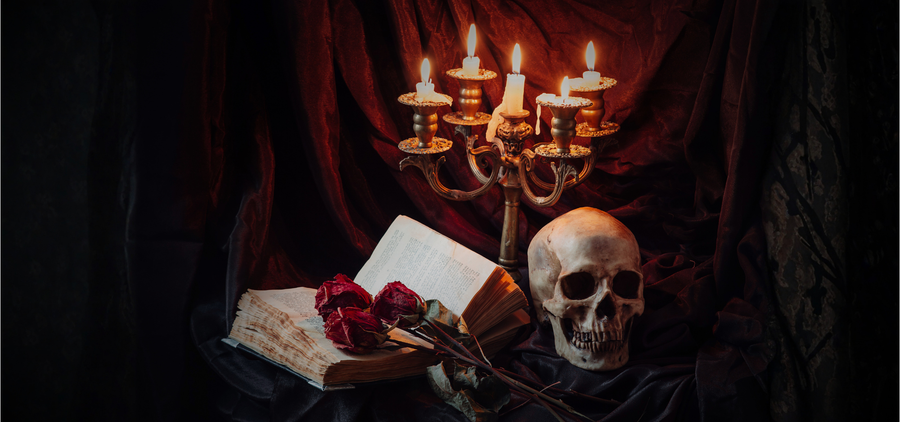
Every vampire story has a smell, even if nobody writes it down. Think about it. A crypt that hasn't been opened in two hundred years. Candle smoke curling up a stone staircase. Cold, damp walls. Old velvet curtains heavy with dust. Earth from a faraway graveyard. Roses left on a tomb by someone who loved too much. And under it all, the faint, metallic promise of what the visitor came for.
Vampires have been seducing and terrifying readers for over two centuries, and perfumers have been trying to bottle them for nearly as long. Here's what a vampire really smells like, according to the stories — and according to us.
A Short History of the Vampire
Blood-drinking spirits appear in folklore all over the world, from the restless dead of Eastern European villages to night demons in ancient myths. In the 18th century, reports of "vampire" cases in the Balkans spread across Europe, complete with exhumed bodies and panicked villagers, and the word entered fashionable conversation. But the vampire we know today — elegant, aristocratic, irresistible and doomed — was born in 19th-century literature.
1819: The Vampyre
In the summer of 1816, a group of writers gathered at the Villa Diodati on Lake Geneva: Lord Byron, his doctor John Polidori, Mary Shelley and Percy Shelley. The weather was so terrible that they stayed indoors and challenged each other to write ghost stories. Mary Shelley began Frankenstein. Polidori wrote The Vampyre, published in 1819, which gave us the first great literary vampire: Lord Ruthven, a cold, charming nobleman who glides through high society. (Many readers believed the character was a not-so-subtle portrait of Byron. Byron was not amused.)
1845–1847: Varney the Vampire
Next came Varney the Vampire, a sprawling, wildly melodramatic serial sold in cheap installments known as "penny dreadfuls." It introduced many of the vampire's classic habits, including fangs and climbing through bedroom windows at night.
1872: Carmilla
Sheridan Le Fanu's Carmilla is a haunting, dreamlike story about a mysterious young woman who arrives at a lonely castle and slowly drains the life from her host. It came out 25 years before Dracula and is still one of the most atmospheric vampire stories ever written.
1897: Dracula
Then Bram Stoker gave us the Count himself. A castle in the Carpathians. Wolves howling in the valley. A doomed ship arriving in a storm. Mist, bats, mirrors and a long fight against an ancient evil. Dracula defined the vampire for everyone who came after.
1922: Nosferatu
F. W. Murnau's silent film Nosferatu was an unofficial adaptation of Dracula, with the names changed. Stoker's widow sued, and a court ordered the copies destroyed — but some survived, and thank goodness they did. Its vampire, Count Orlok, isn't a charming aristocrat but a gaunt, rat-like creature with long fingers and a terrible stillness. His shadow creeping up the stairs is still one of the most famous images in cinema.
Since then, vampires have brooded, sparkled, danced in nightclubs and sulked through several centuries. But the scent of the original stories hasn't changed: stone, earth, smoke and blood.
What Would a Vampire Smell Like?
Earth From Home
In Stoker's novel, Dracula travels to England with fifty boxes filled with the earth of his homeland, because he can only rest in it. So the first note of any good vampire perfume is earth: damp, dark, slightly mineral. In perfume, that comes from patchouli, vetiver, moss and earthy roots. (Packing tip from the Count: always bring your own soil. Hotel pillows are never quite right.)
Cold Stone and Old Crypts
Vampires don't live in apartments with good lighting and underfloor heating. They live in castles, abbeys and family crypts. That means cold stone, dust and still air — notes perfumers build with mineral materials, incense and dry woods. Read more in gunpowder, metal and stone.
Incense and Candles
Vampire stories are full of chapels, crucifixes and candlelit rooms, sometimes as protection and sometimes as irony. The smell of old church incense and melting wax belongs here. See incense in perfumery and the candle wax note.
Dark Roses
A vampire with no roses is just a man who sleeps a lot. The rose is the romance of the story — beautiful, fragile and doomed. In a vampire perfume, it's usually dark, deep and a little bruised. See black rose: dark rose perfumes.
Blood
Of course. But a good vampire perfume uses it the way a good vampire story does: as a hint, a shadow, a promise. Read how it's made in the blood note in perfumery.
Leather and Smoke
Old coats, coach seats, riding gloves and the smoke of a dying fire in a vast stone hall. Leather and birch tar give a vampire perfume its aristocratic, slightly dangerous edge. See smoke and leather.
Absinthe and Decadence
Vampires are creatures of excess. A bitter, green note of absinthe or wormwood adds the decadence of a centuries-long party that never quite ended. See the absinthe note.
And Garlic?
Absolutely not. We considered it for about four seconds, though.
Our Vampire Perfume
NSFRTÅ
NSFRTÅ (pronounced like Nosferatu) began with a name carved into the jagged stones of an abandoned abbey, its meaning lost to time but heavy with dread. On moonless nights, travelers claimed to hear hollow footsteps and a low, guttural hum rising from the crypt. No one dared enter except the desperate or the foolish, drawn by rumors of ancient riches buried in its shadowed halls. They never returned.
The perfume opens with black pepper, smoked birch and absinthe — cold, sharp and a little intoxicating, like the first breath of air inside a sealed tomb. In the heart, dried blood, dark rose and patchouli unfold slowly, velvety and strange. The base is incense, leather, vetiver and ambergris, which lingers on skin for hours like a presence you can't quite see.
It's dark, cold, earthy and ethereal-metallic: stepping into the chilling embrace of a forgotten crypt where danger and temptation are standing very close together. It's also vegan, which we think is a nice touch for a perfume about a blood-drinker.
More Perfumes for Creatures of the Night
- Bloody Mary: metallic pomegranate, rose, incense and leather. Less undead, more royal — but just as stained.
- Gothika: candle wax, incense and century dust in an abandoned cathedral. A vampire's Sunday best.
- Macabre: clove, rose, patchouli and oakmoss from a ballroom where the dancers have been dead for a century.
- Purple Veil: soft, powdery and melancholic, for the pale, Carmilla-like vampire who haunts lonely castles.
- Ondskan: for the vampire who skipped the charm entirely. Blood accord, gunpowder, cold stone and burned resins.
Which Vampire Are You?
- The aristocrat — velvet coat, perfect manners, terrible secrets: NSFRTÅ.
- The romantic — roses, sorrow and moonlit balconies: Purple Veil.
- The queen — power, guilt and a stained crown: Bloody Mary.
- The party vampire — eternal ballroom, endless dancing: Macabre.
- The ancient horror — no charm, no mercy: Ondskan.
Frequently Asked Questions
What does a vampire perfume smell like?
Usually a mix of dark roses, incense, earth, cold stone, leather and a subtle metallic or blood-like note. The goal is atmosphere: a crypt, a castle or a candlelit room.
Is NSFRTÅ inspired by Nosferatu?
Yes. Its name is a nod to Nosferatu, and its story takes place in an abandoned abbey and crypt.
Are vampire perfumes only for Halloween?
Not at all. They're wonderful through the whole cold season, especially for evenings. See the best gothic perfumes for autumn and winter.
Is there real blood in NSFRTÅ?
No. The dried blood note is an accord made from plant materials and aroma molecules, and the perfume is vegan.
Final Thoughts
Vampires have lasted this long because they're never just monsters. They're loneliness, hunger, beauty and fear wrapped in one long black coat. A vampire perfume should feel the same: seductive enough to draw you in, unsettling enough to make you check over your shoulder on the way home.
Wear it after sunset. Obviously.