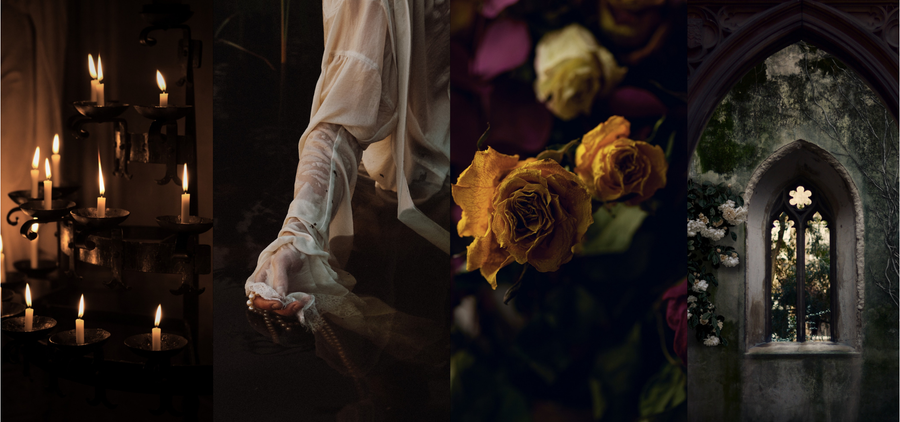
Gothic literature has always been a sensory experience. You don't just read a gothic novel — you smell the damp of the castle walls, the candle guttering at the end of the corridor, the earth of the churchyard, the rain blowing across the moors, the dust in a locked room nobody has entered for forty years. These books were written to be felt in the dark, preferably with a blanket over your knees, a cup of tea going cold beside you and the uneasy suspicion that the house is making noises it didn't make yesterday.
At Dark Tales, gothic literature is one of our biggest inspirations. So we decided to do what every reader secretly wants to do: imagine what these books smell like, and pair each one with a perfume.
Where Gothic Literature Began
The gothic novel was born in 1764 with Horace Walpole's The Castle of Otranto, a story of a cursed castle, an ancient prophecy and a family torn apart — and a giant helmet that falls from the sky and crushes the heir on his wedding day. (Really. It's on the first pages.) It was wildly melodramatic, and readers loved it.
Writers like Ann Radcliffe followed with The Mysteries of Udolpho (1794), full of remote castles, trembling heroines, secret passages and veiled portraits. Matthew Lewis's The Monk (1796) went darker and more scandalous. By the 19th century, the genre was off and running — down a dark corridor, holding a single candle, toward a door that should have stayed closed.
What Makes a Story Gothic?
- A haunted place: a castle, abbey, mansion, ruin or wild landscape.
- A secret from the past: a crime, a curse, a hidden marriage, a buried body.
- Something supernatural — or seemingly so: ghosts, vampires, monsters, visions.
- Extreme emotion: terror, obsession, grief and forbidden love.
- Atmosphere above all: storms, moonlight, fog and candlelight.
Every one of these has a smell. That's where we come in...
The Novels and Their Scents
Frankenstein (1818) — Mary Shelley
Mary Shelley began Frankenstein at the age of eighteen, during the famously stormy summer of 1816 at the Villa Diodati on Lake Geneva, when a group of friends challenged each other to write ghost stories. It became one of the most influential novels ever written — and arguably the first science fiction story.
What many people forget is that the novel opens and closes in the frozen Arctic, where an explorer's ship is trapped in the ice and the creature finally disappears into the polar darkness.
The scent: ice, electric air, cold metal and a laboratory lit by lightning.
Our pairing: Aurora Borealis, with its metallic, icy air under the Northern Lights.
The Fall of the House of Usher (1839) — Edgar Allan Poe
A crumbling mansion beside a dark lake, a crack running down its walls, a sickly brother and sister and a burial that maybe wasn't a burial. Poe was the master of decay, and nobody has ever described a sad, rotting house so beautifully.
The scent: dust, damp wood, old fabric and something that should have stayed in the family crypt.
Our pairing: Haunted Mansion, a house whose family never left.
The Masque of the Red Death (1842) — Edgar Allan Poe
A prince hides from a plague in his abbey with a thousand guests and throws a lavish masked ball through seven colored rooms, the last one black with blood-red windows. At midnight, an uninvited guest arrives. You can probably guess how the party ends.
The scent: powdered wigs, velvet costumes, wine, spice and dread.
Our pairing: Macabre, a ruined ballroom where the dead still waltz.
The Raven (1845) — Edgar Allan Poe
A grieving man, a bleak December midnight, a chamber full of old books, a dying fire and a bird with a one-word vocabulary. The most famous poem in gothic literature is set, fittingly, among volumes of forgotten lore.
The scent: old books, guttering candles, cold stone and grief.
Our pairing: Gothika, with candle wax, incense, century dust and leather-bound books in an abandoned cathedral.
Jane Eyre (1847) — Charlotte Brontë
An orphaned governess, a brooding master, a grand house called Thornfield and strange laughter echoing from the attic at night. And then, a fire.
The scent: candle smoke, old wood, cold corridors and something burning upstairs.
Our pairing: Floating Candles, candles that light themselves in a mansion's empty halls.
Wuthering Heights (1847) — Emily Brontë
Wild moors, howling wind, a ghost tapping at the window and a love so obsessive it outlives everybody involved. It's less a romance than a weather system.
The scent: wet heather, rain, peat, moss and a cold wind from the hills.
Our pairing: Fern Valley, with humid earth, ozone, ferns and oakmoss.
Hop-Frog (1849) — Edgar Allan Poe
A court jester, mocked and mistreated by a cruel king and his ministers, is asked to invent a costume for the royal masquerade. He has an idea. The king and his men are dressed as chained orangutans, hoisted up by the chandelier chain in the middle of the great hall — and the jester finally gets the last laugh, with fire. It's one of Poe's darkest stories, and the jester is its unforgettable avenger.
The scent: candlelit halls, velvet costumes, cold iron chains and a smile that's a little too sharp.
Our pairing: King's Jester, with candle wax, red mandarin, a cold touch of metal, suede leather and oakwood in the corridors of an ancient castle.
Carmilla (1872) — Sheridan Le Fanu
A lonely castle in the forests of Styria, a mysterious young visitor who sleeps all day and a dreamy, unsettling vampire story that came out 25 years before Dracula.
The scent: soft florals, faded lace, moonlight and something hungry underneath.
Our pairing: Purple Veil, a melancholic, powdery floral with a subtle incense veil.
The Picture of Dorian Gray (1890) — Oscar Wilde
A beautiful young man stays young while his portrait in the attic ages and decays with every sin. It's decadence, vanity and horror in a silk dressing gown.
The scent: roses, absinthe, powder and corruption.
Our pairing: Bloody Mary, a beautiful rose stained by what it's done.
Dracula (1897) — Bram Stoker
The Count, his castle, his wolves, his fifty boxes of native earth and a doomed ship arriving in a storm at Whitby. The vampire that started it all.
The scent: earth, stone, blood, smoke and old leather.
Our pairing: NSFRTÅ, our Nosferatu, with dried blood, dark rose and smoked birch. Read more in vampire perfumes.
The Name of the Rose (1980) — Umberto Eco
Not a 19th-century novel, but gothic to its bones. In 1327, a Franciscan friar arrives at a remote abbey in northern Italy just as the monks begin dying one by one. At the center of it all is a vast, labyrinthine library that no one is allowed to enter, and a forbidden book that seems to kill whoever reads it.
The scent: parchment, ink, candle smoke, cold stone and the dust of a library guarding its secrets.
Our pairing: Old Library, which was directly inspired by this book. Its story takes place in a monastery library with a hidden chamber and a sinister tome bound in blackened leather — and a scholar who reads it to the last page.
Our Own Gothic Novel: The Cabinet of Lost Voices
After years of pairing perfumes with other people's stories, we're writing one of our own. The Cabinet of Lost Voices is our upcoming gothic novel, and it will be published alongside a perfume connected to its story.
Few believed the stories surrounding Mourning House, where abandoned rooms still carry the fragrance of those long departed and forgotten letters seem to find their readers decades too late. Eveline Veil comes to the secluded estate to catalog its remarkable collection — and discovers that memory can linger like perfume on old paper, polished wood and faded silk. Beneath the house rests one cabinet that has remained unopened since the autumn of 1882. Some things are preserved not because they should be remembered, but because they must never be disturbed.
Memento Mori
The first preview of the novel. Memento Mori: Part I is a prelude to The Cabinet of Lost Voices, your first glimpse inside Mourning House. Juniper berry, clove, cherry, whiskey and dragon's blood glow over wool, tree moss, oakwood and cedarwood, before sinking into agarwood, aged vanilla, amber and pale musk. Dark, spectral and strangely comforting — like an old house that remembers everyone who ever lived in it.
And From Folklore
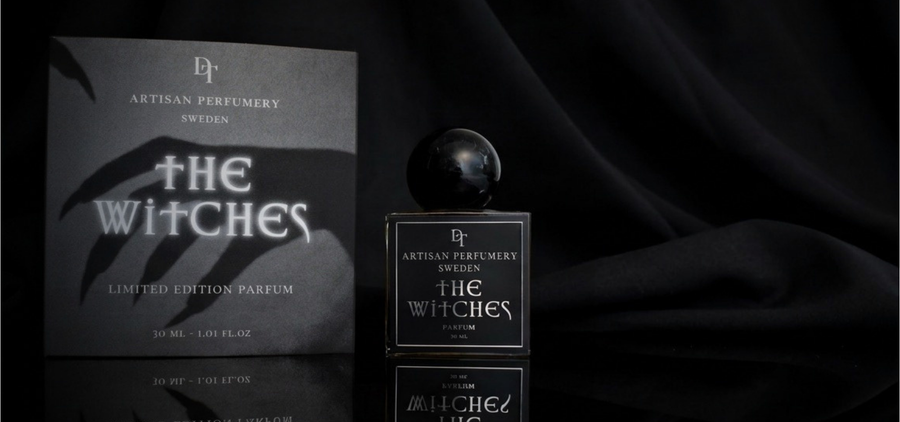
Gothic stories didn't only come from novels. Folk tales gave us witches, forest spirits and curses long before Walpole picked up a pen. Yaga follows Baba Yaga of Slavic folklore into her forest, and Blåkulla follows the witches of Swedish legend across the sea. See witch perfumes.
A Gothic Reading Ritual
Here's our favorite way to read a gothic classic:
- Wait for a dark, rainy evening. (In Sweden it's so dark, you don't even have to wait from October to March.)
- Light a candle and turn off the big lights.
- Put on the book's matching perfume.
- Make tea. Forget to drink it.
- Read until the candle burns low.
- If you hear a tapping at your chamber door, that's just the wind. Probably.
Build your own literary set with a Quadro Set of four samples, and read about bookish scents in perfumes that smell like old books.
Frequently Asked Questions
What was the first gothic novel?
The Castle of Otranto by Horace Walpole, published in 1764, is usually considered the first.
What perfume smells like a gothic novel?
Old Library is our most literary perfume. Gothika, Haunted Mansion and NSFRTÅ also carry strong gothic atmospheres.
Which book inspired Old Library?
The Name of the Rose by Umberto Eco, with its monastery library, forbidden book and deadly secrets.
Is Dark Tales writing a gothic novel?
Yes. The Cabinet of Lost Voices is coming soon, together with a connected perfume. Memento Mori is its first preview.
Which perfume would Dracula wear?
We'd suggest NSFRTÅ: dried blood, dark rose, smoked birch, incense and leather.
Are Dark Tales perfumes inspired by literature?
Many are inspired by history, literature, folklore and dark storytelling. Every perfume begins with its own story.
Final Thoughts
Gothic literature has lasted for more than 250 years because it speaks to something we all feel: the pleasure of being frightened, the beauty of decay and the pull of the dark. Every Dark Tales perfume begins with a story. These are some of the stories that taught us how — and soon, we'll be adding one of our own.