Here's a fun experiment. Next time someone tells you they only like "natural" perfume, ask them what their favorite perfume smells like. Clean skin? Fresh laundry? Rain? The sea? A soft, powdery musk? Chances are, almost everything they love comes from a lab.
Almost every perfume made in the last 140 years contains aroma molecules. They're the reason perfume can smell of rain, clean skin, the sea, snow or a flower that gives no oil at all. They're behind the most famous perfumes in history and the strangest notes in modern perfumery. Yet "synthetic" is still treated as a dirty word, whispered as if it were a confession. Here's what aroma molecules really are, where they came from, how perfumers use them and how safe they are.
What Is an Aroma Molecule?
An aroma molecule is a single fragrant compound. A natural material like rose oil is a mixture of hundreds of these molecules, like an orchestra. An aroma molecule is a single instrument — one violin, one cello — or sometimes an instrument nobody had ever heard before.
They fall into three broad groups:
- Isolates: molecules separated from a natural material, such as linalool from ho wood or eugenol from clove.
- Nature-identical synthetics: molecules found in nature but made in a lab, such as vanillin or coumarin. Chemically, they're (almost) exactly the same as the natural versions. Your nose can't tell the difference, and neither can a chemist (sometimes can be found under the name "truabs").
- Novel synthetics: molecules that don't occur in nature, such as Iso E Super, Calone or Ambrox. These give perfumers smells that no plant can offer — new colors on the palette.
A Short History of Aroma Molecules
Modern perfumery began, as so many good things do, with an accident in a chemistry lab. In 1856, a teenage English chemist named William Perkin was trying to make quinine, a malaria medicine. He failed — and accidentally created mauve, the world's first synthetic dye, which made him rich and turned Victorian fashion purple almost overnight. A few years later, in 1868, the same Perkin made coumarin, the sweet, hay-like molecule found in tonka beans.
In 1882, Houbigant used coumarin in Fougère Royale, which gave its name to a whole fragrance family. Vanillin, the main scent molecule of vanilla, was first synthesized in 1874, and Guerlain's Jicky (1889) became one of the first great perfumes built on synthetics.
The discoveries kept coming. Synthetic musks were found by accident in 1888, by a chemist working on explosives. Ionones, the scent of violets, were discovered in 1893. And in 1921, Chanel No. 5 made aldehydes famous with their bright, soapy, champagne-like sparkle — a perfume that smelled not like a flower, but like an idea.
After the Second World War, the pace sped up:
- Ambrox (1950): a warm, mineral molecule that recreates ambergris.
- Hedione (1962): a transparent, airy jasmine molecule now found in a huge share of all perfumes.
- Galaxolide (1965): a soft, clean musk behind the smell of fresh laundry.
- Calone (1966): a marine, melon-like molecule that defined the "ocean" perfumes of the 1990s.
- Iso E Super (1973): a velvety, woody molecule that gives a perfume radiance and a skin-like glow. It became so beloved that in the 2000s, it was even sold on its own as a single-molecule perfume.
How Are Aroma Molecules Made?
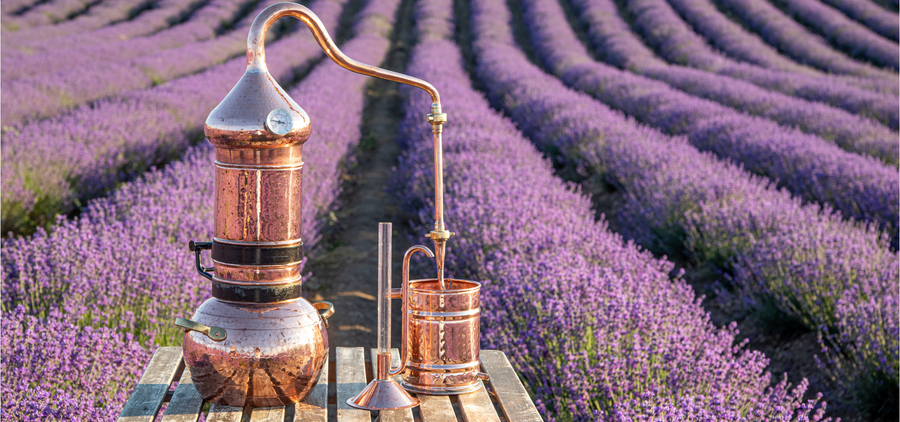
There's no single recipe. Some aroma molecules are made from petrochemicals. Others are made from renewable natural sources: pine turpentine, citrus peel, clary sage (which gives sclareol, the starting point for Ambrox) or plant sugars. More and more are now made through biotechnology, using fermentation to produce molecules from renewable materials — a little like brewing beer, but much better smelling.
Many fragrance houses also develop "captives": new molecules they patent and keep for their own perfumers for years before anyone else can use them. It's one of the most secretive corners of the industry.
How Perfumers Use Aroma Molecules
Aroma molecules do jobs that naturals can't:
- Recreating "mute" flowers: lily of the valley, lilac and freesia give no natural extract, so they can only be built from molecules. See floral absolutes.
- Replacing animal materials: synthetic musks and Ambrox have replaced deer musk and most ambergris. See animal materials in perfumery.
- Creating abstract smells: rain, ozone, snow, metal, clean skin and "air" don't come from a plant.
- Adding radiance and longevity: many molecules project well and last for hours.
- Keeping a perfume consistent: a molecule smells the same every time, while a natural changes with each harvest.
- Protecting endangered plants: sandalwood molecules save real sandalwood trees.
Aroma Molecules in Dark Tales Perfumes
At Dark Tales, we use aroma molecules alongside organic essential oils, absolutes and CO2 extracts. Many of our strangest and most atmospheric notes simply couldn't exist with naturals alone:
- Gothika: cold stone walls and gothic powder of an abandoned cathedral.
- Aurora Borealis: crisp, faintly metallic night air under the Northern Lights.
- Haunted Circus: powdery rubber balloons, theater makeup and a fog machine.
- NSFRTÅ: a dried blood accord in a cold, ethereal crypt.
- Ondskan: gunpowder, cold stone and burned resins.
Are Aroma Molecules Safe?
Aroma molecules are among the most thoroughly tested materials in cosmetics. The Research Institute for Fragrance Materials (RIFM) assesses their safety, and IFRA turns those findings into limits on how much can be used. In the EU, the Cosmetics Regulation adds its own legal limits on top.
When a molecule turns out to be a problem, it's restricted or banned. Lilial, a popular lily of the valley molecule, was banned in EU cosmetics in 2022 over reproductive toxicity concerns. Several early nitro musks were banned or restricted for similar reasons. The system isn't perfect, but it keeps learning.
Natural isn't automatically safer. Many natural materials contain the same molecules that are restricted as synthetics, and some, like oakmoss, are among the most tightly limited materials in perfumery. Read more in naturals vs. synthetics and fragrance allergens explained.
Are Aroma Molecules Cruelty-Free?
In most cases, aroma molecules are the cruelty-free choice. They've replaced deer musk, civet and castoreum, which all came from animals that were killed or caged.
Animal testing is a separate question. In the EU, testing cosmetic products and their ingredients on animals has been banned since 2013. Some chemicals can still be tested under general chemical safety law, for worker and environmental protection rather than cosmetics, which is an ongoing debate in the industry. No Dark Tales perfume is tested on animals.
Frequently Asked Questions
Are synthetic perfume ingredients bad?
No. Aroma molecules are safety-assessed and regulated, and many are identical to molecules found in nature.
What is Iso E Super?
A woody, velvety aroma molecule created in 1973 that adds radiance and a skin-like glow to perfume.
Is vanillin natural?
Vanillin occurs naturally in vanilla, but most vanillin in perfume and food is made in a lab. Chemically, it's identical.
Do Dark Tales perfumes contain synthetics?
Our main line combines natural materials with aroma molecules. Our Arina Franzén | Botanical Perfumery line is fully natural.
Final Thoughts
Aroma molecules aren't the opposite of nature. Many are taken from nature or copy it exactly, and the rest expand what perfume can say. Without them, there would be no fougère, no Chanel No. 5, no lily of the valley and no smell of rain in a bottle. They're not shortcuts. They're new words in the language of scent.