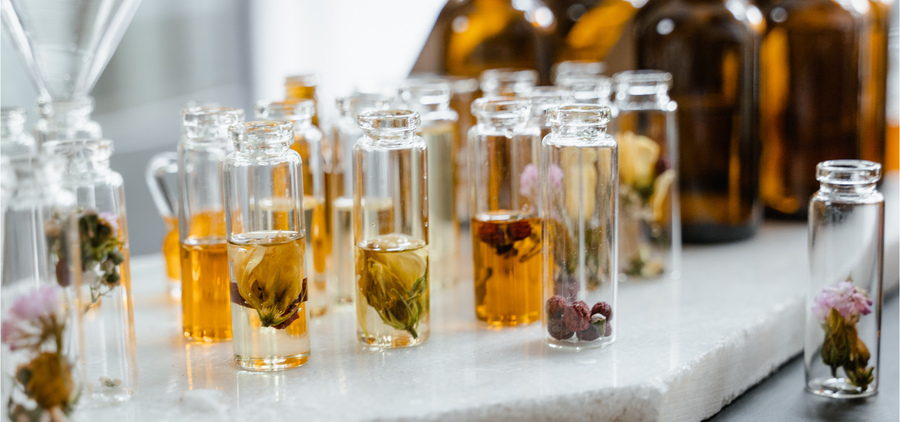
Every natural material in a perfume begins somewhere very far from the bottle. A jasmine flower in an Egyptian field at dawn. A lemon on a Sicilian tree. A frankincense tree clinging to a rocky hillside in Oman. A strip of birch bark from a Scandinavian forest. Before any of them can become perfume, their scent has to be drawn out — and the way it's done changes everything.
Rose otto and rose absolute come from the same petals, yet they smell noticeably different: one bright and dewy, the other deep and honeyed. A smoky birch tar and a fresh birch leaf oil come from the same tree, but you'd never guess it. Extraction is where perfumery begins, and it's part science, part craft and part ancient magic. Here are the main methods perfumers use, what each one produces and how the results compare.
1. Steam Distillation
Steam distillation is one of the oldest and most common ways to get essential oils from plants. If you've ever seen a copper still glowing in a lavender field in Provence, you've seen it in action:
- Plant material is placed in a distillation chamber.
- Steam passes through it and carries off the volatile compounds.
- The steam is cooled back into liquid, and the essential oil separates from the water, floating on top like a golden film.
The water left behind still carries some scent. It's called a hydrosol, or floral water — the same rose water and orange flower water you might find in a Middle Eastern kitchen or a grandmother's bathroom.
Examples include: Essential oils of lavender, eucalyptus, clove, sandalwood, cedarwood, patchouli, neroli, petitgrain, geranium, ylang-ylang, clary sage, rosemary, peppermint, basil, vetiver, juniper, cypress, pine, lemongrass, fennel, black pepper, cardamom, cinnamon leaf, etc.
2. Hydrodistillation
Hydrodistillation is the older, simpler version of steam distillation, and probably the method our ancestors used first. Instead of steam being passed through the plant material, the material is fully submerged in water, and the water is boiled. The rising steam carries the oil with it, and it's condensed and separated in the same way.
This suits materials that steam can't pass through evenly. Rose petals, for example, clump into a dense mass in a steam still. Rose otto, the classic rose oil of Bulgaria and Turkey, is made this way, in big copper stills filled with petals and water, and it takes several tons of petals to make a single kilo. In India, the traditional deg bhapka method distills flowers straight into sandalwood oil to make attars, a technique that has barely changed in centuries.
Examples include: Rose otto, agarwood (oud) oil, traditional Indian attars, and hydrosols such as rose water and orange flower water, etc.
3. Dry Distillation
Dry distillation, also called destructive distillation, uses no water at all. It's the most dramatic method on this list:
- Wood or bark is heated in a closed vessel with very little air.
- As it breaks down, it gives off vapors that are collected and condensed.
- The result is a dark, tarry oil that smells smoky, leathery and burnt.
Raw tars are harsh — imagine a campfire, a tire workshop and a smokehouse having a loud argument — so they're usually rectified, or distilled again, before they go into perfume. Birch tar is the smell behind the classic Russian leather perfumes, and it's still one of the best ways to bring smoke and leather into a composition. Read the full story in smoke and leather.
In our collection, smoked birch opens NSFRTÅ, and cade wood smolders in the base of Blåkulla.
Examples include: Birch tar, cade oil (from juniper wood), pine tar, beech tar, etc.
4. Expression (Cold Pressing)
Have you ever peeled an orange and felt a fine, fragrant spray hit your face? That's expression in miniature. Citrus peels hold their oil in tiny sacs just under the surface, and the simplest way to get it out is to press it. No heat is involved, so the oil stays bright and close to the smell of freshly cut fruit:
- The fruit or its peel is rolled, pricked or pressed by machine to burst the oil sacs.
- The oil is rinsed off with water and collected.
- The oil and water are separated, usually in a centrifuge.
In the past, it was done by hand: workers in Sicily and Calabria pressed peels against sponges and squeezed the oil out into clay bowls. Bergamot from Calabria is still one of the most important citrus oils in perfumery. It's often sold as "FCF" (furocoumarin-free), with the compounds that can make skin sensitive to sunlight removed.
Citrus oils are the bright opening of countless perfumes — but they're also the most fleeting. They evaporate quickly, which is why the citrus sparkle at the top of a perfume often disappears within minutes.
Examples include: Oils of bergamot, lemon, lime, sweet orange, bitter orange, blood orange, mandarin, tangerine, clementine, grapefruit, citron, yuzu, etc.
5. Solvent Extraction
Solvent extraction is used for flowers too delicate to survive heat, like jasmine and tuberose. Put jasmine in a steam still and you get something thin and disappointing. Extract it gently with a solvent, and you get the full, lush, living flower. It works like this:
- The raw material is mixed with a solvent, usually hexane or ethanol.
- The solvent dissolves the aromatic compounds, along with waxes and pigments.
- The mixture is filtered and concentrated into a waxy substance called a concrete.
- The concrete is washed with alcohol to separate out the aromatic compounds, and the result is an absolute.
For more on the flowers themselves, see our guide to floral absolutes.
By-Absolute and Floral Waxes
- By-absolute is the waxy residue left once the absolute has been separated out. It still carries some scent and can be used in candles, solid perfumes and cosmetics, and occasionally in perfume, though it doesn't always dissolve fully in carrier oils.
- Floral waxes are another by-product of solvent extraction. They're mostly plant wax holding on to some of the flower's scent, and they're often used in skincare and solid perfumes — a good way to use material that would otherwise be thrown away.
Examples include: Absolutes of jasmine, tuberose, osmanthus, mimosa, rose, ylang-ylang, iris, narcissus, orange blossom, violet leaf, champaca, lotus, frangipani, honeysuckle, vanilla, tonka bean, tobacco, hay, etc.; floral waxes (jasmine, rose, tuberose, violet, orange blossom); by-absolute — rose, sandalwood, etc.
6. Resinoids
When solvents are used on dried materials — resins, balsams, mosses and roots — the result is called a resinoid rather than an absolute:
- The dried material is soaked in a solvent such as ethanol or hexane.
- The solvent is evaporated, leaving a thick, sticky extract.
Resinoids are dense and very long-lasting, which makes them some of the most important base materials in perfumery. They're behind much of the warmth in amber accords and the darkness in incense. Some are processed further into absolutes. If you've ever touched raw labdanum, you'll know it's one of the stickiest substances on earth — perfumers joke that once it's on your fingers, it's there until next week.
Resins are the heart of dark perfumery. Read more in incense in perfumery.
Examples include: Labdanum, benzoin, myrrh, frankincense, opoponax, elemi, galbanum, styrax, Peru balsam, tolu balsam, oakmoss, treemoss, etc.
7. Tincturing
Tincturing means steeping a material in alcohol for a long time. It's slow, patient and a little like making homemade liqueur. It draws out both volatile and non-volatile compounds:
- The raw material is crushed or chopped and covered with high-proof alcohol.
- It's left to sit for weeks or months while the alcohol takes on its scent.
- After filtering, what's left is a tincture, a mild aromatic extract.
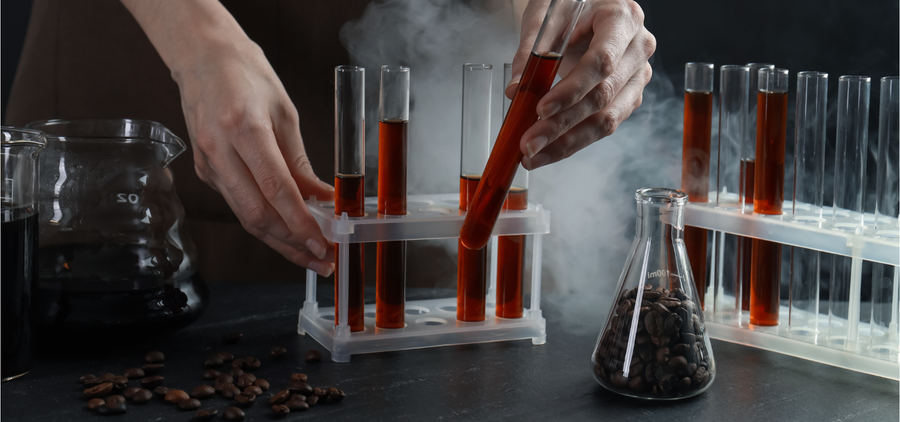
Many artisan perfumers make their own tinctures from everyday materials like vanilla pods, coffee beans, cocoa nibs or tea leaves. Some tinctures, like ambergris, are said to keep improving for years, like a fine wine in a cellar.
Tincturing is also the traditional way of working with animal materials such as ambergris, hyraceum, civet and castoreum. We cover those in animal materials in perfumery.
Examples include: Tinctures of vanilla, tonka bean, coffee, cocoa, orris (iris) root, tobacco, tea, ambergris, hyraceum, frankincense, labdanum, oakmoss, benzoin, styrax, etc.
8. Maceration
Maceration means soaking a material in a carrier oil or alcohol. Unlike tincturing, it usually involves some warmth:
- Plant material is chopped and placed in the oil or alcohol.
- Gentle heat helps release its aromatic compounds.
It's one of the oldest techniques of all. Ancient Egyptians, Greeks and Romans made scented oils by soaking flowers, herbs and resins in warm oil, and the result was used for anointing, massage and perfume. If you've ever made garlic oil or herb-infused olive oil in your kitchen, congratulations: you've macerated.
The two terms overlap, and people often use them loosely. Here, tincturing means long, cool steeping in alcohol, and maceration means shorter, warm steeping, often in oil.
Examples include: Macerates of vanilla, cinnamon, clove, orange peel, rose, jasmine, nutmeg, saffron, ginger, chamomile, calendula, coffee, etc.
9. Enfleurage
Enfleurage is a traditional method for very delicate flowers, and it's rarely used today. It's also one of the most romantic and labor-intensive processes in perfume history:
- Fresh petals are laid on a glass plate coated with odorless fat.
- The flowers are replaced daily until the fat is saturated with their scent.
- Alcohol then pulls the scent out of the fat, and the result is an absolute.
Picture workers in 19th-century Grasse, laying thousands of jasmine and tuberose flowers by hand onto glass frames, day after day, for weeks. It was so costly in time and labor that solvent extraction almost completely replaced it by the early 20th century. Today, only a few artisans still practice it, mostly to keep the tradition alive.
Examples include: Enfleurage absolutes of jasmine, tuberose, gardenia, orange blossom, violet, jonquil, etc.
10. CO2 Extraction
CO2 extraction is a modern method that uses pressurized carbon dioxide as the solvent — the same gas that puts the bubbles in your sparkling water:
- Under high pressure, CO2 becomes a supercritical fluid that behaves partly like a gas and partly like a liquid.
- It extracts the aromatic compounds without high heat.
- When the pressure is released, the CO2 turns back into gas and leaves a clean extract behind.
CO2 extracts often smell remarkably close to the raw material: vanilla CO2 smells like a split vanilla pod, ginger CO2 like freshly cut ginger root, coffee CO2 like a bag of freshly roasted beans. They're one of the great gifts of modern technology to natural perfumery.
Examples include: CO2 extracts of frankincense, myrrh, vanilla, chamomile, sandalwood, rose, ginger, blackcurrant bud, peppermint, patchouli, pink pepper, black pepper, cardamom, coffee, cacao, saffron, etc.
Newer and Related Techniques
Phytonic extraction. A gentle, low-temperature method that uses hydrofluorocarbon solvents in place of hexane or CO2. The extracts are clean and close to the raw material, but the method is still uncommon.
Fractional and molecular distillation. These don't extract anything new. They refine an existing oil or absolute by separating it into parts. Perfumers use them to remove allergens from oakmoss, take the dark color out of patchouli or isolate the lighter "heart" of a material.
Headspace technology. Instead of extracting a material, headspace captures the scent molecules in the air around it — a living flower, a forest floor, an old book. The sample is analyzed, and the scent is rebuilt in the lab. This is how perfumers can recreate flowers that won't give a usable extract, like lily of the valley. Read more in aroma molecules.
Traditional Indian choya. In India, some materials are made by roasting rather than distilling. Choya nakh, for example, is made by roasting seashells and capturing the smoke, giving a smoky, leathery, marine material. It's the source of the roasted seashell note in Black Waters.
How the Method Changes the Scent
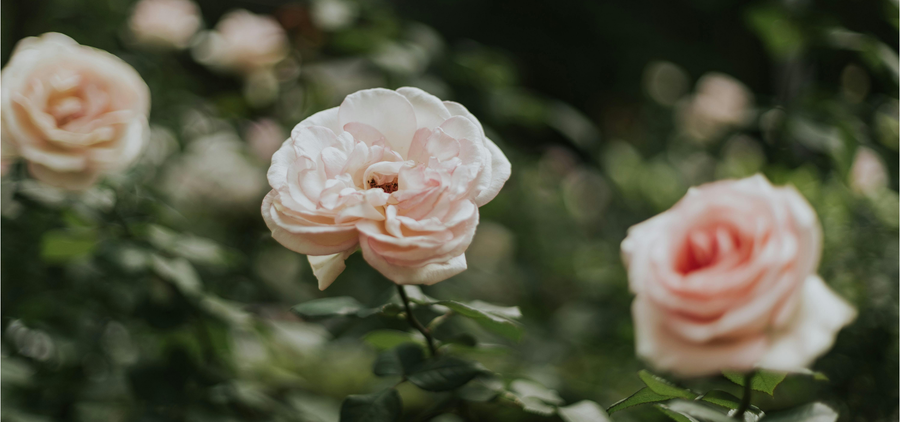
- Rose otto vs. rose absolute: Rose otto is fresh and bright, with a slightly green, honeyed edge. Rose absolute is deeper and sweeter, closer to the smell of a full-blown rose in a vase.
- Vanilla absolute vs. CO2 extract: Vanilla absolute is thick, rich and deeply creamy. Vanilla CO2 is brighter and fresher, and often closer to the smell of the bean itself.
- Ylang-ylang essential oil vs. absolute: The essential oil is lighter and fresher. The absolute is creamier and stronger, with more weight at the base.
- Orange blossom absolute vs. neroli: Both come from bitter orange flowers. Neroli, distilled, is fresh and citrusy; the absolute is warm, honeyed and indolic.
- Rose and sandalwood by-absolutes vs. essential oils and absolutes: By-absolutes are waxier and much less fragrant. They usually play a supporting role in solid products. They can be used in perfume, but carefully, since they may not fully dissolve in carrier oils.
Frequently Asked Questions
What is the most common extraction method in perfumery?
Steam distillation, used for most essential oils.
What is the difference between an essential oil and an absolute?
Essential oils are usually distilled with steam or water. Absolutes are made with solvents, which capture heavier, more delicate parts of the scent.
How are citrus oils made?
Most are cold-pressed from the peel, a method called expression.
What is a CO2 extract?
An extract made with pressurized carbon dioxide, which captures scent without high heat and often smells very close to the raw material.
Is enfleurage still used?
Rarely. It's mostly practiced by a few artisans to keep the tradition alive.
Final Thoughts
No single method is best. Each one captures a different side of a material, which is why a perfumer might use two versions of the same ingredient in one perfume — rose otto for brightness and rose absolute for depth. Knowing how an ingredient was made tells you a lot about how it will smell.
And the next time you spray a perfume, think of the long journey behind it: the fields, the forests, the copper stills, the patient hands. Every drop has traveled a very long way to reach your skin.